Flora & Fauna of Austria:
Animals & Plants of the Alps

The animals and plants that you might encounter is Austria are exceptionally diverse. For example, there are approximately 43,000 native species of animals in the country, whereas Germany - being much larger than Austria and having access to the sea - has 48,000 species, only 5,000 more.

This diversity reflects the diversity in Austria's physical geography: It ranges from highly alpine ecosystems to the steppe lakes of the Burgenland in the East. Different altitudes accommodate different ecosystems. Key factors that support diversity in the animal and plant kingdoms beyond the geography are local climates and the chemistry of the soil, often determined by the rock that forms the base of a certain landscape.
But there are also (pre)-historical reasons why Austria is a hot spot for birdwatchers, plant enthusiasts and other worshippers of biodiversity. In the early tertiary (approximately 70 million years ago), the vegetation of the today's Austria was similar to the one found in mountainous rain forests of Southeast Asia today. In the late tertiary (approximately 25 million years ago), heat-loving plants gradually disappeared.
Life shaped by Ice Ages
By the time the ice ages hit the Alps, most of the local vegetation consisted of fur trees and various species of broad-leaved trees. During the Ice Ages, plant species from northern Europe migrated to those areas north of the Alps that were not covered by glaciers. Certain mountains peaked out of the glaciers like islands and gained a flora and fauna distinct for this period.

One such incident is the Kapuzinerberg Mountain in the city of Salzburg, which still has species of animals and plants you normally wouldn't find in Central Europe. Arctic species of plants often found new grounds in the Alps and the other way round - the Ice Age was a period of exchange between alpine and arctic ecosystems. This included both plants and animals: the fauna you would consider to be typically alpine today consists of animals that have migrated from the Caucasian Mountains, the Baltic region and arctic Europe.
As always with drastic changes, it took centuries or millennia to bring ecosystems into a balance with newly arriving species. Keep in mind that particularly "difficult" niches like those in alpine areas are often very sensitive to change - a problem often seen today in cases of pollution or environmental damages.
Attractions of the Animal & Plant World
What are the big hits in terms of animals and plants in Austria? For birdwatching, stay in the East, in particular around the National Park Neusiedler See with its 320 species of birds over the course of a year. You can see Europe's only species of Bee Eaters (Merops apiaster), the continent's heaviest bird, the Great Bustard (Otis tarda), large populations of wild geese (Anser anser). Nearby rivers and lakes, you can see kingfishers (Alcedo atthis) and herons (Ardea cinerea). The country is rich in birds of prey, in particular harrows and falcons, but also vouchers and Austria's heraldic animal, the eagle Haliaeetus albicilla.
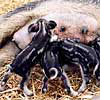
In terms of reptiles, the most notable ones are the beautiful, large lizard Lacerta viridis and the grey snake Natrix natrix. From the mammal point of view, look out for wild boars (Sus scrofa), badgers (Meles meles), chamois (Rupicapra rupicapra), ibex (Capra ibex), deer (Capreolus capreolus and Cervus elaphus) and foxes (Vulpes vulpes). You will most likely not see any of the very few bears (Ursus arctos) of Austria, recent immigrants from Slovenia.
If you drive up the Großglockner Hochalpenstraße or anywhere else in properly alpine terrain, it is likely that you will see marmosets (Marmota marmota), very funny little guys.
Excited about plants? Too bad I am a zoologist and not a botanist; but I suggest to look in particular for Edelweiß (the one featuring in "The Sound of Music") and Enzian, the two "National flowers" of Austria. If you want a quick-and-easy approach to typically alpine flora, watch out for the small natural history exhibition by the Großglockner Hochalpenstraße, which includes a little garden with alpine flowers.
If you are generally willing to cheat when learning on Alpine flora and fauna, try the botanical gardens in Salzburg (next to the Faculty of Science), the Alpenzoo ("Alp Zoo") in Innsbruck, the Museum of Natural History in Vienna or the "Haus der Natur" in Salzburg - all great places when travelling with children, too. Visitor Centres in National Parks always have exhibitions on the local flora and fauna, too.
Proper References
If you have a semi-professional interest in the flora and fauna of Austria (and if you speak German), I can recommend the books "Vegetationsflora Österreichs" by Schmeil-Fitschen and the "Brohmer - Fauna von Deutschland". Both books require some knowledge about the use of determination keys and a fairly good understanding of biology. However, they do cover practically all species you could possibly encounter in Austria (apart from the odd treasure).
Further Reading
Environmental Issues in Austria
back to "background"
